Punsch or Glühwein? What to order at the stalls
A Vienna market evening runs on hot drinks, and the first choice at every stand is Glühwein or Punsch. This guide explains the difference and the deposit on the mug, then goes through the food at the stalls and the markets that cook with more care. It ends with Viennese food beyond the huts, from coffee houses to the sausage stand, and with eating over Christmas, when much of the city shuts.
Glühwein or Punsch, and the alcohol-free cup
Glühwein is the drink most visitors already know, red wine heated with spices and sugar. Punsch is the Viennese favorite. It is a hot punch made on a base of fruit juice or tea, usually with rum in it, and the boards above the stands list flavor after flavor. It also tends to be stronger than Glühwein, which is easy to forget when it tastes mostly of fruit, so two cups on an empty stomach hit harder than you expect.
Kinderpunsch is the alcohol-free version. It is made for children, but drivers order it too, and on a long evening it is a good way to pace yourself between the stronger cups. A drink costs a few euros, and the first one at each market costs more because of the mug.
The mug and the deposit
Hot drinks come in ceramic mugs, and with your first drink you pay a refundable deposit on the mug, the Häferlpfand. Hand the mug back at a stand when you are done and the deposit comes back to you. Keep it, and the deposit becomes the price of a souvenir. Each market commissions its own design, and many change it from one year to the next, so a mug from the Freyung and one from Schönbrunn make two different keepsakes.
Collecting them has become a small hobby. Some visitors buy one drink at every market on an evening walk and fly home with a shelf of mugs. If you plan to, rinse them at the hotel and pack them in the middle of your suitcase, wrapped in a sweater. Cards are widely taken at the stands, but keep a little cash for the smaller stalls.
What to eat at the stalls
Market food in Vienna is eaten standing at a high table, mug in one hand. These are the classics to look for.
- Maroni. Roasted chestnuts, hot enough to warm your gloves on the way to the next market;
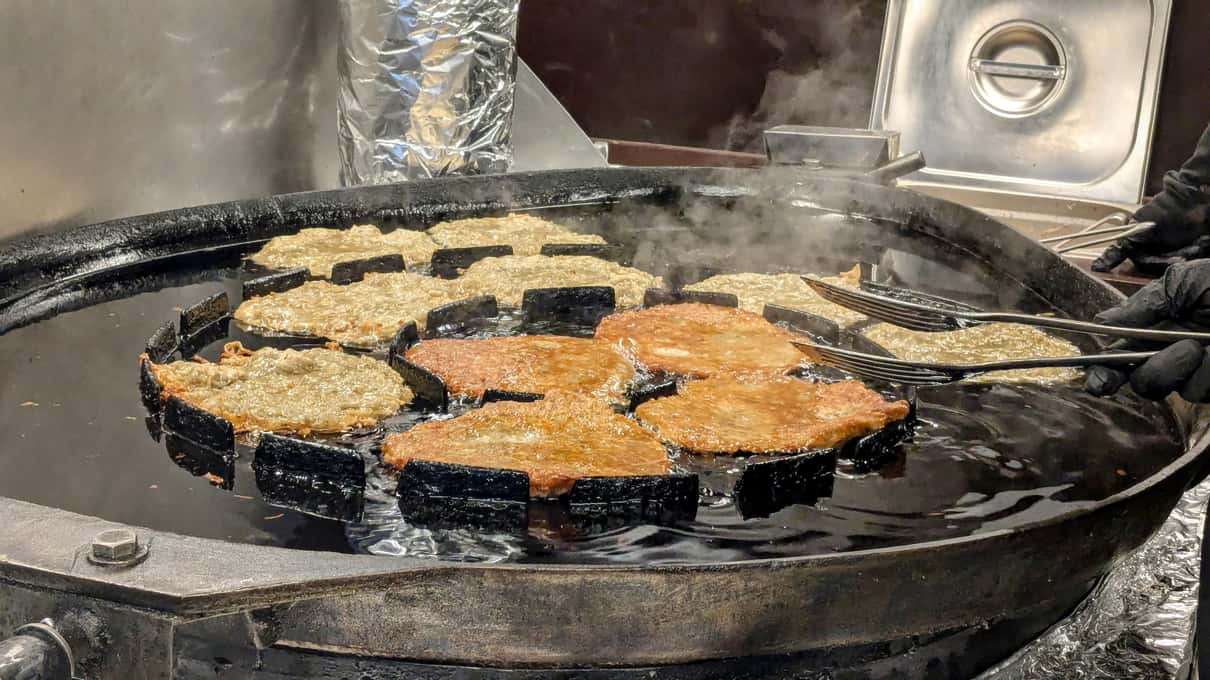
- Roast potatoes and potato pancakes. Fried in wide pans until golden, and filling enough to count as supper;
- Langos. A Hungarian flatbread fried in oil, usually rubbed with garlic and sometimes topped with cheese;
- Baumkuchen or chimney cake. Sweet dough baked on a turning spit, then rolled in sugar;
- Kaiserschmarrn. A thick pancake torn into pieces in the pan and dusted with powdered sugar, often with plum compote on the side;
- Käsespätzle. Small egg noodles baked with melted cheese and topped with fried onions;
- Sausages and Käsekrainer. The Käsekrainer is a smoked sausage with small pockets of cheese that melt as it grills;
- Lebkuchen and Vanillekipferl. Gingerbread and crescent-shaped vanilla cookies, the two sweets to buy in a bag for later.
Where the food is better
The big squares are built for volume, and for a better plate the smaller markets are usually the safer bet. Art Advent on Karlsplatz sticks to organic food, and its kitchens stay open until 9 pm, an hour after the stalls close. At Am Hof the food carries on until 10 pm. Spittelberg mixes food gifts in among the crafts in its old lanes, and the student market on the old university campus stays open until 10 pm from Monday to Thursday and until 11 pm on Fridays and Saturdays. Each market posts its final dates and opening times shortly before the season starts, so look at its own page before you count on a late supper there. Our guide to the Old Town markets and Spittelberg has the details, and the Rathausplatz guide covers the stalls in front of the City Hall.
The easiest way to find the good stands is to follow someone who already knows them. Venture Vienna's market food and drinks walk, from ~$140 (about $159 on Viator), sets off from near Am Hof for roughly four hours. Metro and tram rides link four lesser-known markets on the way, including one in the 7th district and the student market on the old university campus. Tastings range from Käsespätzle to Kaiserschmarrn, with hot drinks along the way and alcohol-free ones on request. Small groups top out at eight, or six on the private option, and guides such as Gloria earn warm words. The catch is how little history it has so far, a perfect 5.0 resting on just 14 GetYourGuide reviews and 10 on Viator. It cannot cater for food allergies, and most of it happens outdoors in the cold.
Viennese food beyond the markets
Stall food is only half the story. For the dishes the city eats the rest of the year, Intrepid Urban Adventures' food and coffee walk, from ~$145 on GetYourGuide and about $150 on Viator, fills five and a half hours. It meets at WEIN & CO on Jasomirgottstraße 3-5, by Stephansplatz, and opens with coffee and a homemade pastry in a coffee house. The metro then carries you out to the Viktor-Adler-Markt in Favoriten for a Jause, the Viennese snack of open sandwiches, with mulled wine or a spritzer. Next come Eismarillenknödel, apricot dumplings made with ice cream at a local institution, and Krapfen from a family bakery.
Lunch is a proper sit-down meal of Wiener Schnitzel or Tafelspitz, the boiled beef Vienna is proud of, with a vegetarian option, then Kaiserschmarrn and a glass of wine or beer. The walk ends at a Würstelstand in Ottakring, a sausage stand where Käsekrainer and goulash wait. Metro tickets are included. Expect about 1.2 miles (2 km) on foot, in a group of up to 16. Ratings sit at 5.0 on Viator (1,278+) and on GetYourGuide (338+), with guides such as Maria or Wolfgang singled out in reviews. The catch is the length and the cost. It is not recommended for children under 12, gluten-free eating is hard on a route this full of pastry, tips are extra, and a few reviewers found it pricey.
From a coffee house to a sausage stand
Five and a half hours with Intrepid Urban Adventures, from a coffee house near Stephansplatz to a Würstelstand in Ottakring, with a seated lunch in between, from ~$145. Skip breakfast, and keep this one for the adults.
Coffee houses and Sachertorte
Between markets, the warmest place to sit is a coffee house. Vienna's coffee house culture is on UNESCO's list of intangible heritage, and the ritual matters as much as the coffee. Order a Melange, the classic, close to a cappuccino, and nobody will hurry you out. Café Central and Demel are the famous names, and Café Sacher is where people go for the original Sachertorte. The famous houses can draw queues, and any neighborhood café does the same job for a warm half hour. A coffee and a slice of cake also fit neatly after a morning in the palaces or before an evening concert.
Eating over Christmas, 24 to 26 December
Christmas Eve is the main event in Austria. Shops and most markets close in the afternoon of the 24th, and families gather at home that evening to open the presents the Christkind brings. The 25th and 26th are both public holidays with the shops shut. For a visitor, that means planning meals ahead. Book a table for those evenings as early as you can, and check that the restaurant opens at all on the 24th.
The markets help. On Christmas Eve several stay open with shorter hours, the City Hall square until 6:30 pm. Schönbrunn, Maria-Theresien-Platz, Stephansplatz and Rathausplatz all keep trading on the 25th and 26th, so a supper of Käsespätzle and Punsch at a stall is always within reach. Our dates and hours guide lists the exceptions market by market. Traveling with children? Vienna at Christmas with kids has the markets with rides and Kinderpunsch, and our December weather guide explains how to stay warm while you eat standing up.