How cold is Vienna in December, and what to wear?
December in Vienna is cold rather than bitter, and grey far more often than white. The day is short, with the sun gone around 4 pm, which is exactly why the market lights matter so much. This guide covers how to dress for hours of standing on wet cobbles, and where to thaw out between stalls when the drizzle sets in.
What a December day feels like
A typical December day in Vienna peaks at about 37 °F (3 °C), and nights sit around freezing or dip a little below it. Those numbers sound mild on paper. What makes them bite is the damp and the wind, which finds its way across open squares such as Rathausplatz and Maria-Theresien-Platz. Skies stay grey on most days, and drizzle comes more readily than snow. When snow does fall in the city, it rarely lasts.
None of this is dangerous cold. It is the slow chill of standing in one spot for an hour with a mug in your hand, and it creeps up through your feet first. Dress for that, and Vienna in December is a pleasure.
Short days, bright markets
The sun rises around 7:45 am and sets around 4 pm, which leaves roughly eight hours of daylight. That sounds like a drawback, but it works in your favor at the markets. The huts are lit from late afternoon, so the lights are on by the time most people finish sightseeing, and you do not have to stay out late to see them at their best. In grey daylight the same stalls look rather plain.
Give the daylight to indoor sights or a trip out of town, and save the markets for after dark. Most open by 10 or 11 am and close at 9 or 10 pm. The organizers confirm opening dates and times shortly before every season, so look at each market's own page, or start with our guide to dates and opening hours.
What to wear for an evening on cobbles
| What to pack | Why it matters |
|---|---|
| A thermal base layer | You stand still for long stretches, and that is when the cold gets in |
| A wool sweater or fleece | Easy to open up in a heated tram or coffee house |
| A water-resistant coat with a hood | Drizzle is far more common than snow |
| Waterproof boots with a good grip | Wet cobbles and slush get slippery after dark |
| A warm hat and gloves | Thin gloves let you hold a mug without taking them off |
| A small backpack | Keeps both hands free for a mug and a plate |
Layers beat one heavy coat, because a Vienna evening moves in and out of warm rooms all the time. One minute you are on a cold square, the next in a heated tram or a crowded coffee house. Something you can open and close keeps you from overheating indoors and shivering at the next stall. Leave the smart shoes in the hotel unless you are heading to a concert, and even then a pair of boots for the walk there is a good idea. Families should add a spare pair of gloves per child; Vienna at Christmas with kids has more on keeping small hands warm.
Snow in the city, snow in the Alps
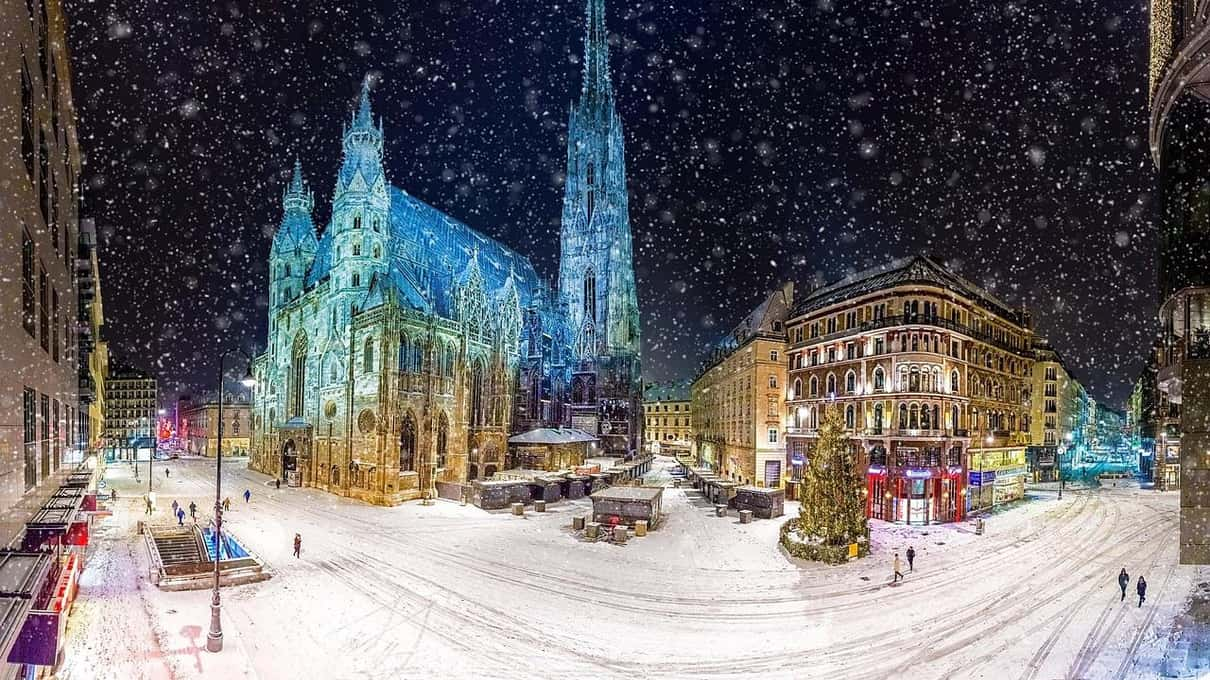
Snow comes and goes in Vienna, and it rarely stays on the ground for long. On the odd night when it settles on Stephansplatz, the huts below the cathedral look like a Christmas card, but you cannot plan a trip around it. The Alps are another matter. The Salzkammergut, with Hallstatt on its lake, is far more likely to be white, although snow is never guaranteed there either.
The easy way up there in winter is 7 TRAVEL's Hallstatt day trip, from ~$73. The coach leaves from Albertinaplatz, stops at Schloss Ort on the Traunsee and gives you about three hours in the village, then returns around 8:15 pm. Reviewers give it 4.7 on GetYourGuide (7,164+) and 4.6 on Viator (1,479+), where it sells for about $102. The catch is some 8 hours on the road, and food is not included. Our day trips guide compares it with Salzburg and Bratislava.
Chasing snow for a day
A coach from behind the State Opera to Hallstatt and back in about 13 hours, with three hours in the lake village and the Skywalk as an option, from ~$73. Snow is likelier there than in Vienna, though never certain.
Warm places between the stalls
The Viennese coffee house is the city's answer to a cold afternoon, and its culture sits on UNESCO's list of intangible heritage. Order a Melange and nobody will hurry you. The best known are Café Central and Demel, while the original Sachertorte belongs to Café Sacher.
Museums make a longer break. The Kunsthistorisches faces the Christmas village on Maria-Theresien-Platz, so you can spend the afternoon with the paintings and step straight out to the stalls at dusk. Palace interiors work the same way, and the state rooms are in our palaces in winter guide.
For an hour of music in the warm, Classic Ensemble Vienna's concert in the vaults of St. Peter's, from ~$55, sits a few steps off the Graben. Its catch is a program with more Vivaldi and Mozart than carols, and filming is not allowed. For a bigger night, the Vienna Mozart Orchestra at the Musikverein, from ~$77, dresses its 30 players in wigs and period costume and adds two opera singers. It is rated 4.6 from 6,213+ reviews on GetYourGuide and 4.3 from 956+ on Viator, about $79 there. Its catch is that gallery seats can have limited views, and what you get is a show in costume aimed at visitors, not the Vienna Philharmonic. Our concerts guide compares the options.
A plan for a wet day
- Spend the morning indoors at a palace or the Kunsthistorisches, when the rooms are calmest;
- Take a long lunch in a coffee house, with a Melange and a slice of cake to finish;
- At dusk, pick a market right by a U-Bahn station, such as Stephansplatz on the U1 and U3, so the dash from the train is short;
- Warm up with a Punsch, then duck into St. Peter's for the evening concert;
- If the rain stops, walk the Graben under its chandeliers of light on the way back.
Our Punsch and food guide says what to order at the stalls, hot and otherwise, once you are back out in the cold.